Leading from the “Deputy” Space
Khadija Mahmud’s story of Quiet Influence
Khadija joined EFAC in 2017 through the EFAC-Kijabe Children Education Fund (KCEF) partnership. Determined and driven from a young age, she pursued her dreams relentlessly and is now a Bachelor of Science in Software Development graduate from KCA University. Today, as the Founder of Founder NOVULead Hub she serves as a community leader, driving grassroots change initiatives and is the recipient of the 2025 EFAC Lynda Trumbull Community Service Award for her commitment to service, education, and community upliftment.
In this story of quiet influence, Khadija shares how quiet influence, grounded in humility, service, and culture, is redefining leadership from the “deputy” space.
In many communities, leadership is often associated with titles, visibility, and authority. But for Khadija, a proud daughter of the Nubian community in Kibera, leadership has taken on a different meaning, one rooted in humility, service, and influence.
Growing up in Kibera - the largest slum area in Kenya, Khadija witnessed both the beauty and complexity of tradition. While culture provided identity, belonging, and resilience, it also shaped expectations around the role of women in leadership. More often than not, women were expected to take supportive positions, the organizers, the helpers, the “deputies” standing quietly behind the scenes.
For some, that space might feel limiting. For Khadija, it became a place of discovery.
Redefining the “Deputy” Role
“Through my journey as an EFAC scholar, mentor, and an emerging leader, I have come to see that influence is not always tied to titles. Sometimes the people creating the greatest impact are the ones building bridges between vision and community.” Khadija says.
Rather than viewing the “deputy” role as second-best, she now sees it as a powerful position of trust and service.
Khadija believes leadership is often demonstrated through reliability, consistency, and humility; qualities that quietly shape communities from within.
Influence Through Service
By becoming dependable and committed to serving others, Khadija has learned that trust carries more weight than status. Leadership, in her view, is less about recognition and more about responsibility.
“To be frank, my journey has also taught me that humility is not weakness. True leadership does not always demand attention. Sometimes, the strongest voices are those grounded in purpose rather than applause. I want to do what I do not to get the recognition but for someone else to feel the impact,” she says.

Khadija at one of her community sessions.
The Strength of Culture
For Khadija, culture is not something to overcome; it is the foundation she stands on.
Her Nubian heritage has deeply shaped her understanding of leadership and community.
Growing up in a community that understands perseverance has taught her how to navigate challenges with strength and determination. That resilience continues to fuel her ambitions and aspirations.
Respect as Leadership Currency
Khadija believes meaningful leadership begins with respecting people, traditions, and shared values. By honoring where people come from, she creates space for conversations about growth and change.
To her, leadership is never an individual achievement. It is collective. Every opportunity she receives becomes an opportunity to uplift her community, her peers, and the next generation of young leaders.
Influencing the Future
As she continues to grow professionally and personally, Khadija remains committed to becoming the kind of leader who creates change without disconnecting from her roots.
Her story is a reminder that leadership does not always begin at the front of the room. Sometimes, it begins in the quiet spaces through service, influence, resilience, and the courage to challenge expectations with grace.
Khadija is not forcing her way to the top.
She is influencing her way forward and in doing so, redefining what leadership can look like for young women in her community and beyond.
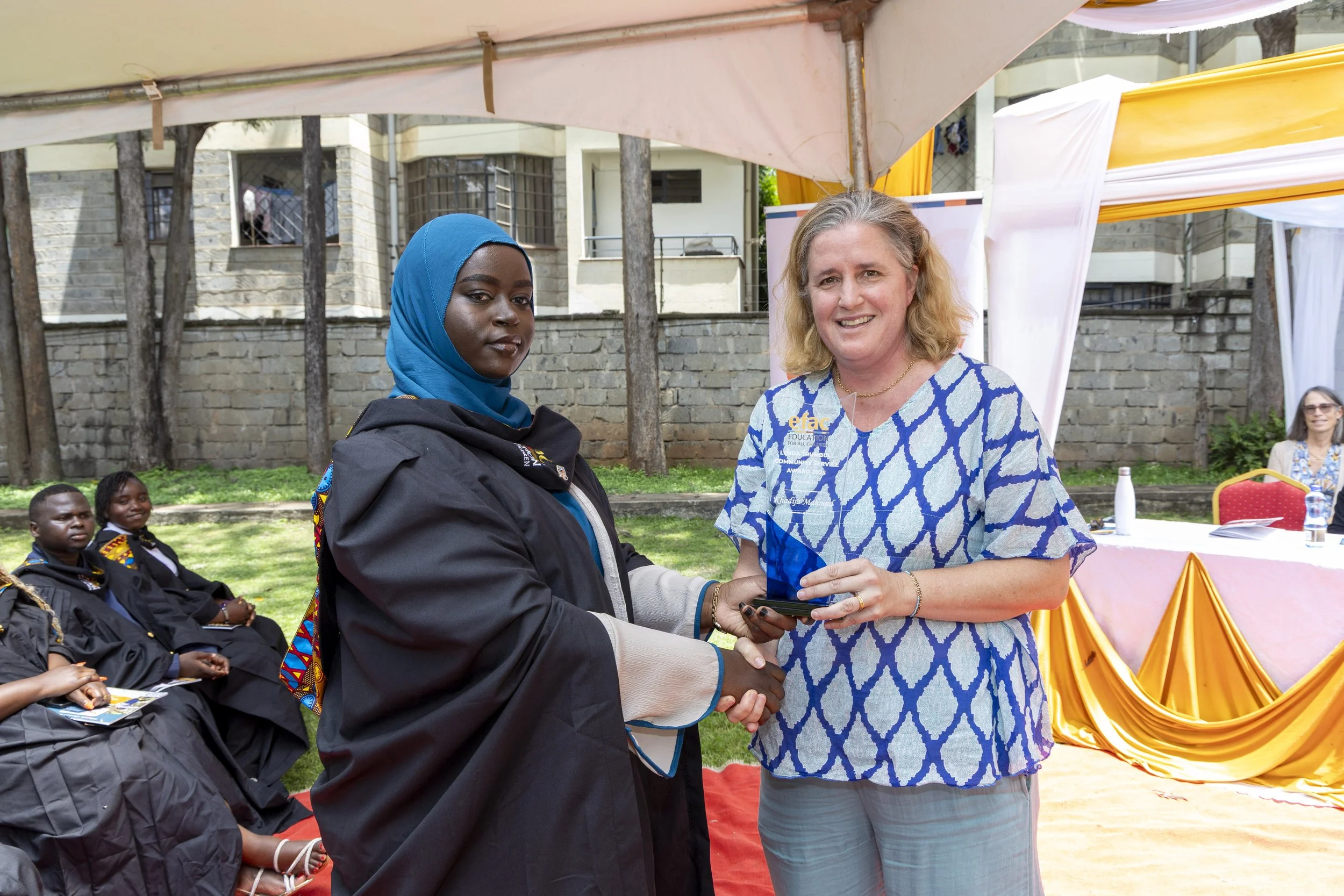
Khadija receives the Lynda Trumbull Community Service Award from EFAC Board Member Nina Henning at the Wezesha Graudation Ceremony in November 2025.